
Oatmeal Cookie Sourdough Bread
Oatmeal Cookie Sourdough Bread
Rachel Pardoe
1 loaf
1 hours
50 minutes
303
Breakfast
24 hours
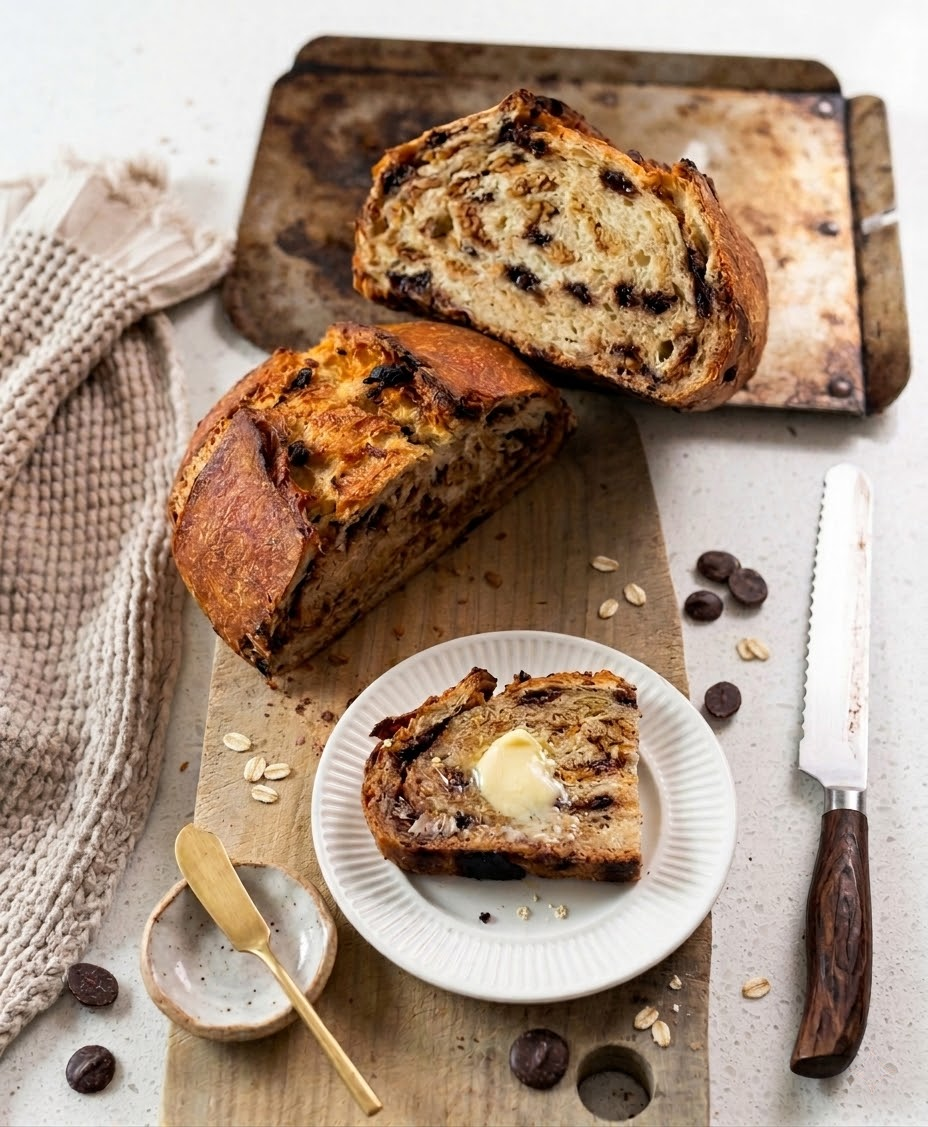
What happens when an old-school oatmeal cookie and an artisanal sourdough loaf have a baby? You get The Oatmeal Cookie Sourdough loaf. It has all the nostalgic comfort of your favourite childhood cookie packed inside a delicious, warm loaf of sourdough. The loaf is the perfect breakfast to accompany coffee - hearty, filling, and carries just enough sweetness to feel like a treat without making you feel like you've broken the rules before noon.

Sourdough Oatmeal Cookie Recipe Ingredients
Here’s what you’ll need to make this tasty loaf:
Rolled oats – Old-fashioned dry rolled oats provide a deeply rustic texture and nutty flavor once pan-toasted. Avoid instant oats here, as they break down too quickly and lose their bite.
Unsalted butter – Melted and combined with the oat mixture to give your baked cookie clusters that signature rich, melt-in-your-mouth quality.
Brown sugar – Adds a rich, molasses-infused sweetness and essential moisture to the inclusion clusters, mimicking a true classic cookie.
Egg – One medium egg binds the toasted oats, sugar, and butter together, allowing you to bake them into perfect, crunchy clusters.
Water – The hydration base for your dough. Room temperature water works best to keep your fermentation moving along smoothly.
Sourdough starter – Ensure your starter is active, bubbly, and maintained at 100% hydration to help carry the heavy, sweet inclusions through a strong rise.
Bread flour – A high-protein bread flour is essential for this recipe to build a strong gluten network capable of holding the weight of the oats and chocolate chips without collapsing.
Fine sea salt – Tightens the gluten structure and cuts through the sweetness of the sugar and chocolate to balance the overall flavor profile of the crumb.
Semi-sweet chocolate chips (or any other oatmeal cookie inclusion that you want!) – Create gorgeous, melty pockets throughout the loaf. If you want to keep things entirely traditional, you can easily swap these out for raisins!
Tools and Equipment
While you don't need fancy kitchen gadgetry to make this artisanal loaf, having a few specialized tools makes handling a high-inclusion dough and achieving that perfect blistered crust so much easier.
Here’s what I use:
Skillet or Frying Pan – Essential for pan-toasting the dry rolled oats. Toasting them on a dry surface before mixing helps release their natural oils, bringing out a deeply aromatic, nutty flavor that carries through the entire bake.
Food Processor – The secret to infusing the dough base itself with an authentic cookie flavor. A quick blitz turns a portion of your raw oat and brown sugar mixture into a fine powder that blends seamlessly into your flour during the initial mix.
Baking Sheet & Parchment Paper – Used to bake the remaining oat mixture into a thin, crispy cookie. Once cooled, this cookie is easily broken down by hand into crunchy, bite-sized cookie clusters.
Covered Bread Cloche – A heavy, covered baking vessel is the absolute key to a spectacular oven spring. It traps the moisture radiating from the dough, creating a localized steam chamber that keeps the crust soft during the initial rise before letting it crisp up beautifully.
Sharp Lame – Cutting through a dough packed with dense chocolate chips and crunchy baked oat clusters requires a razor-sharp edge. A dedicated sourdough lame allows for clean, deliberate scoring lines without snagging or dragging the inclusions.
Ingredients
Cookie Inclusion
- 135g uncooked rolled oats
- 45g unsalted butter, melted
- 85g brown sugar
- 1 medium egg
- Pinch sea salt
Dough
- 330g tap water
- 100g 100% hydration active sourdough starter
- 460g bread flour
- 8g fine sea salt
Other inclusions
- 115g inclusions of choice (I used semi-sweet chocolate chips, you can add raisins, or both - with the total weight being 115g)
Directions
Prepare Inclusions
Pan-toast your dry rolled oats in a skillet over medium heat. Stir frequently, toasting the oats until they become aromatic and take on a light golden-brown colour. Remove from heat and let them cool slightly.
In a small bowl, mix together all the cookie inclusion ingredients, including the toasted oats.
Weigh out 100g of this mixture, and blitz it in a food processor until smooth. Set this aside (it will be incorporated in your main dough).
Spread the remaining cookie mixture thinly onto a parchment-lined baking sheet.
Bake at 375°F (190°C) for 10 to 15 minutes, or until the edges are browned. Let it cool completely to room temperature.
Once cooled and crisp, use your hands to break the baked cookie sheet into small, bite-sized clusters, roughly 3/8” (approx. 1cm) in size.
Mix the dough and laminate inclusions
In a large mixing bowl, combine all of your dough ingredients, along with the 100g of the blitzed, raw cookie mixture. Mix by hand until no dry flour remains and a shaggy dough forms. Cover the bowl and let it rest for 30 minutes.
Perform a coil fold. Allow the dough to rest, covered, for 30 minutes.
Perform a second coil fold. Allow the dough to rest, covered, for 30 minutes.
Turn dough out onto an unfloured countertop and, from the middle, gently pull the dough out using your fingers to coax the dough to stretch further. Ensure slow stretching to prevent the dough from tearing. Moving around the edge of the dough, continue to pull it outward until you have achieved a roughly 12" x 15" rectangle (30cm x 38cm).
Take half of your baked oat cookie clusters and scatter them evenly over two-thirds of the dough's length. Sprinkle half of your chocolate chips (or raisins) evenly over the top of the cookie bits.
Take the corners of the remaining one-third of the dough (the section without inclusions) and fold it over, covering half of the filled section.
Fold the dough over once more, completing a neat letter fold so the dough is now in a long, three-layered strip.
Scatter the remaining cookie clusters and chocolate chips across the entire surface of the folded dough strip. Starting from the bottom edge, gently but snugly roll the dough up into a tidy cylinder.
Place your shaped dough, seam-side up, into a dusted banneton. Cover and leave it to ferment at room temperature until it has roughly doubled in size and feels light and puffy to the touch. Once bulk fermentation is complete, transfer the covered banneton to the refrigerator for an overnight cold proof.
Bake the dough
In the morning, place your covered bread cloche or Dutch oven inside the oven and preheat to 425°F (220°C).
Carefully turn your cold dough out onto a piece of parchment paper or a dough sling. Dust with a little flour and score the surface using a sharp lame.
Using the parchment paper, carefully lower the dough into your preheated cloche. Cover with the lid and bake for 45 minutes. Remove the lid and continue baking uncovered for an additional 10 minutes to brown the crust. If you find the crust is browning too quickly, you may tent the dough with aluminum foil
To check for doneness, gently tap the bottom of the loaf—it should sound hollow. If you are using a digital thermometer, the internal temperature should register 195°F (91°C). If it needs more time, return it to the oven in 5-minute increments.
Transfer your finished loaf to a wire cooling rack. Allow it to cool completely for at least 1 hour before slicing. Enjoy!